
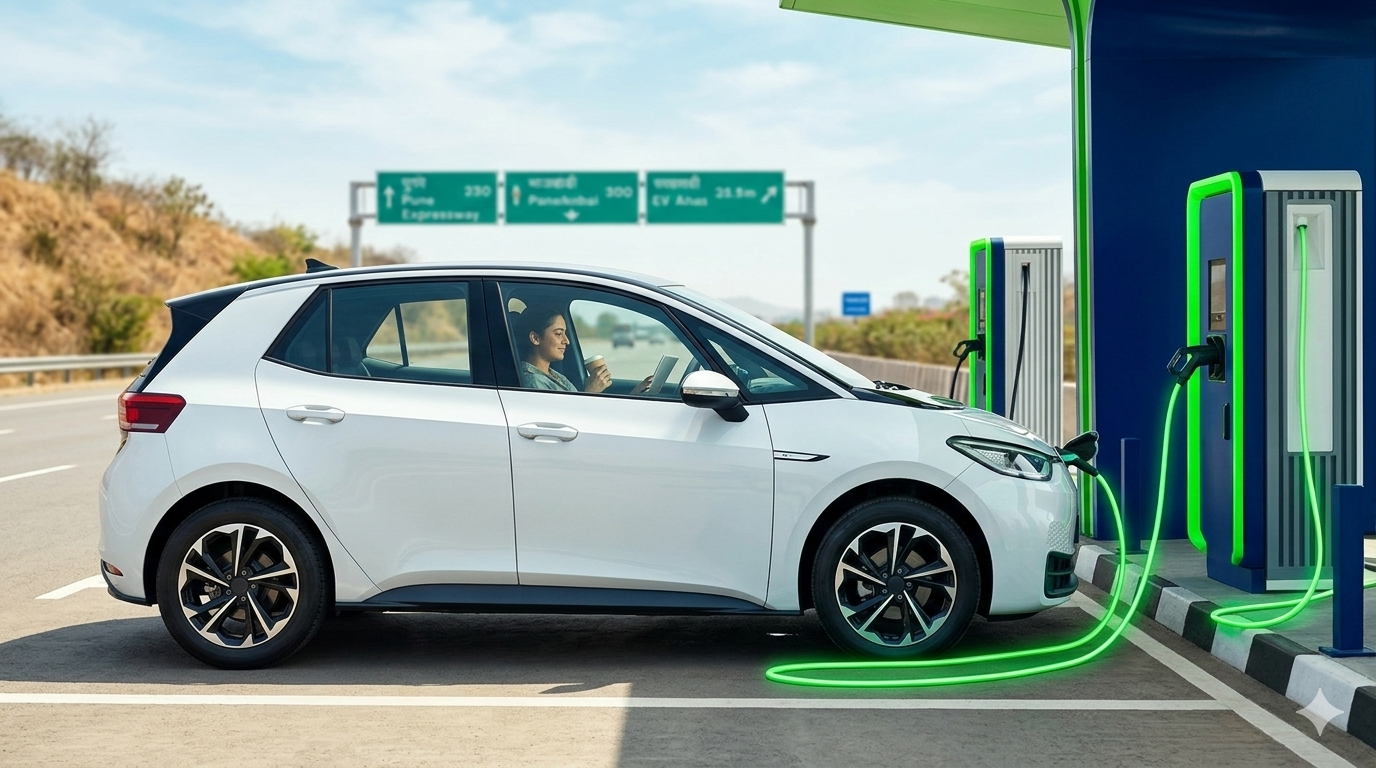
When passengers hear "electric cab" for the first time, a handful of questions come up almost immediately. Can it make it to Mumbai without stopping? What if the battery dies on the Expressway? Is it actually safe at highway speeds? These are fair questions — but they are based on assumptions about EVs that stopped being accurate several years ago.
Orbitmiles has completed over 3,000 trips on the Pune–Mumbai corridor in electric vehicles. Not one has ended prematurely due to range, charging failure, or a safety incident. Here is the evidence-backed answer to every concern we hear.
Myth 1: "EVs can't cover 180 km without stopping to charge"
This is the most common concern — and the easiest to put to rest. The Pune–Mumbai Expressway route is approximately 150–180 km depending on pickup and drop locations. Modern EVs have a real-world range of 300–400 km on a single charge.
The MG ZS EV, for example, delivers a certified range of 461 km under ARAI test conditions and a real-world highway range of 300–330 km. The Kia Clavis EV offers similar highway performance. Even the Citroën EC3 — the most compact vehicle in the Orbitmiles fleet — covers 200+ km per charge under normal conditions.
For comparison, the US Environmental Protection Agency (EPA) certifies most modern electric vehicles at over 320 km (200 miles) of range — a benchmark the Pune–Mumbai trip comfortably fits within. Indian ARAI certification figures are consistently above this threshold for the vehicles in our fleet.
Myth 2: "There are no charging stations between Pune and Mumbai"
This was partially true three years ago. It is not accurate today. The Mumbai–Pune Expressway corridor and the NH-48 alternative route now have multiple fast-charging stations operated by Tata Power, EESL, and private operators. Lonavala, Khopoli, and Panvel all have operational EV chargers.
However, this is largely academic for Orbitmiles passengers. Because our vehicles depart Pune fully charged and the route is well within single-charge range, a charging stop is not part of a standard booking. Orbitmiles pre-checks every vehicle's state of charge before departure — you will never board an Orbitmiles EV with insufficient range for your trip.
For round trips or multi-stop bookings where charging becomes relevant, Orbitmiles coordinates routes and timing to ensure a charging stop is seamlessly built into the schedule — with zero impact on your arrival time.
Myth 3: "Electric vehicles are less safe at highway speeds"
Electric vehicles are, in several measurable ways, safer than conventional petrol or CNG vehicles for highway travel.
- Lower centre of gravity: Battery packs are mounted in the floor, significantly lowering the vehicle's centre of gravity compared to a top-heavy engine layout. This improves stability during cornering and reduces rollover risk on the Expressway.
- No flammable fuel tank: EV fires occur at a far lower rate than petrol vehicle fires per kilometre driven. The lithium-ion battery packs in modern EVs have multiple thermal management and isolation systems that activate before any thermal event can develop.
- Advanced driver assistance: The MG ZS EV, Kia Clavis EV, and Innova Hycross all include lane departure warnings, automatic emergency braking, and forward collision alert as standard — features that are optional add-ons on most conventional cab alternatives.
- Single-speed drivetrain: EVs have no gearbox. The smooth, stepless power delivery removes the sudden acceleration surges that can occur with manual gear changes — particularly relevant on the Expressway at speed.
Orbitmiles drivers are additionally trained in defensive driving specific to EV characteristics, including regenerative braking management and highway battery performance.
Myth 4: "EV cabins are cramped and uncomfortable"
The opposite is consistently true — and passengers notice immediately after their first EV ride.
A CNG cab carries a large pressurised cylinder, typically mounted under the boot floor or in the boot itself. This eliminates usable luggage space and often raises the boot floor significantly. A conventional petrol cab has a transmission tunnel running through the centre of the cabin floor, reducing legroom for rear-seat passengers on either side.
EVs have neither. The Kia Clavis EV and MG ZS EV have flat floors, larger boots, and more legroom per seat than their CNG-converted equivalents. Passengers frequently comment on being surprised by how spacious the cabin is.
Myth 5: "EVs will be too slow on the open highway"
Electric motors deliver torque instantly — from zero RPM, with no gear change required. This means EVs accelerate more smoothly and responsively than any petrol equivalent at any speed.
The MG ZS EV produces 143 bhp and reaches 100 km/h in under eight seconds. The Kia Clavis EV is similarly capable. On the Pune–Mumbai Expressway, where the speed limit is 100–120 km/h, both vehicles cruise well within their comfort zone with power to spare for overtaking.
Orbitmiles vehicles maintain the same highway cruise speeds as any premium cab alternative. Trip durations are identical — typically 3–3.5 hours — with the added benefit of a smoother, quieter ride throughout.
Why These Myths Persist
Most EV concerns come from early-generation electric vehicles — typically small city cars with ranges under 150 km, slow charging infrastructure, and limited cabin space. Those vehicles were real, and the concerns about them were valid. But the vehicles Orbitmiles operates are fifth-generation EVs designed specifically for the kind of performance that makes intercity travel comfortable.
The best way to understand the difference is to take the trip once. Most first-time Orbitmiles passengers ask to book again before they reach their destination.
For more on why an EV cab is the right choice for this route, visit the Why Electric page. You can also read the detailed electric cab Mumbai to Pune guide or compare the vehicles available in the best EV vehicles for intercity cab travel in India.
Frequently Asked Questions
Can an electric cab complete the Pune to Mumbai trip without charging?
Yes. The Pune–Mumbai route is approximately 150–180 km one way. Modern EVs in the Orbitmiles fleet have a real-world range of 300–400 km per charge — well over twice the trip distance. No mid-route charging stop is needed on a standard booking.
Are there EV charging stations between Pune and Mumbai?
Yes. The Expressway corridor has multiple fast-charging stations at Lonavala, Khopoli, and Panvel. However, since Orbitmiles vehicles cover the full route on a single charge, charging en route is not needed for standard one-way trips.
Are electric vehicles safe for highway travel?
Yes — and in several ways, EVs are safer. They have a lower centre of gravity from floor-mounted batteries, which improves highway stability. They carry no flammable fuel tank. The MG ZS EV and Kia Clavis EV include lane departure warnings, automatic emergency braking, and forward collision alerts as standard.
Does an EV cabin feel cramped compared to a CNG cab?
No — the opposite is true. Without a CNG cylinder or transmission tunnel, EVs offer more legroom, a flatter floor, and a larger boot than CNG-converted equivalents. The Kia Clavis EV and MG ZS EV are consistently described by passengers as more spacious than they expected.
Will an EV cab be slow on the Pune–Mumbai Expressway?
No. Electric motors deliver instant torque, meaning smooth and responsive acceleration at all speeds. Orbitmiles EVs cruise comfortably at 100–120 km/h on the Expressway. Trip duration is identical to a conventional cab — typically 3–3.5 hours.