
Every Pune–Mumbai regular knows the pain of the Khandala ghat section. Two steep bends, trucks climbing at 30 km/h, visibility dropping to 50 metres in a monsoon downpour, and the occasional landslide warning that can shut the expressway for hours. That stretch has been the single biggest source of delay and unpredictability on an otherwise world-class highway.
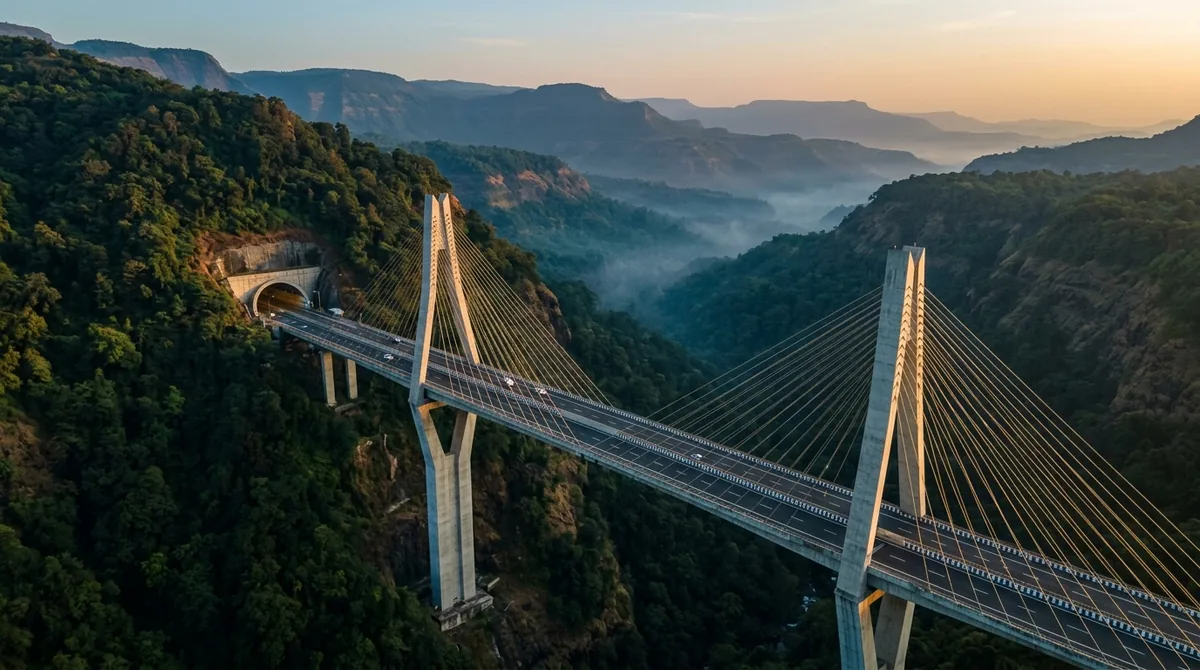
That has now changed. The Mumbai–Pune Expressway Missing Link — under construction since 2019 — opened on May 1, 2026, Maharashtra Day, inaugurated by Chief Minister Devendra Fadnavis. The project includes Asia's widest twin tunnels (23.3 metres across, passing 170 feet beneath Lonavala Lake) and a cable-stayed bridge, and earned a Guinness World Record for the world's widest underground twin tunnel.
This post covers what the Missing Link is, exactly how much time it saves on your Pune–Mumbai cab journey, what happens to toll charges, and how to travel it.
The Mumbai–Pune Missing Link opened in 2026 and cuts 25–30 minutes off the journey by bypassing the slow Khopoli–Kusgaon ghat section with twin tunnels and a cable-stayed bridge. It shortens the route by roughly 6 km, reduces landslide exposure in the monsoon, and — for electric cabs like Orbitmiles — remains toll-free under Maharashtra's EV exemption.
What Is the Mumbai–Pune Missing Link?
The Missing Link is a 13.3-kilometre bypass that replaces the older ghat section between Khopoli (Mumbai side) and Kusgaon (near Lonavala, Pune side). Instead of climbing and descending the Sahyadri hills on open road, the new stretch goes directly through them.
The two tunnels: An 8.87 km tunnel and a 1.68 km tunnel bore straight through the hills. The longer of the two will be among the longest road tunnels in India. Both are designed with modern ventilation, lighting, and emergency response systems.
The cable-stayed bridge: A 650-metre bridge with pylons rising up to 182 metres — taller than the Bandra-Worli Sea Link pylons. It crosses a deep ravine that would otherwise require a long winding detour.
The viaduct: An 850-metre viaduct completes the alignment, connecting the tunnels and the bridge into a continuous flow.
Before vs After: What Changes for Your Cab Journey
| Journey Aspect | Before Missing Link | After Missing Link |
|---|---|---|
| Route distance Pune–Mumbai | ~150 km | ~144 km |
| Expressway travel time | ~90 min | ~65 min |
| Total door-to-door (off-peak) | ~3–3.5 hrs | ~2.75–3 hrs |
| Ghat section exposure | Open road — rockfall risk in monsoon | Twin tunnels — weather-protected |
| Peak monsoon delay risk | 30–60 min + landslide closures | Minimal — tunnels bypass the vulnerable stretch |
For a standard off-peak trip from central Pune to central Mumbai, the time saving is 25 to 30 minutes. In monsoon conditions, the saving is larger — often 45 to 60 minutes — because the new tunnels bypass the rockfall-prone stretch entirely.
Will Cab Fares Change?
Orbitmiles fixed fares will remain stable. The route becomes 5.7 km shorter — a marginal change in distance. The base Pune–Mumbai fare structure (₹2,700 for Citroën EC3, ₹3,200 for MG ZS EV, ₹3,800 for Kia Clavis EV, ₹7,200 for Innova Hycross) stays the same. You get the same price for a faster, more reliable journey.
Toll charges on the expressway may see modest revisions after the Missing Link opens. MSRDC has indicated toll collection is likely to continue until 2060 to recover the project's expanded infrastructure cost. Electric vehicles continue to benefit from Maharashtra's EV toll exemption — read more on the EV toll exemption saving ₹320 per trip.
Missing Link Toll Charges (2026)
One of the most searched questions around the opening is about Mumbai–Pune Missing Link toll charges. Here is what is known and what to expect.
The Missing Link is part of the Mumbai–Pune Expressway network operated by MSRDC. It does not carry a separate standalone toll — the new stretch is covered under the expressway's integrated toll system, so you pay the regular expressway toll, not an extra Missing Link charge. The standard car toll on the Mumbai–Pune Expressway is around ₹320 (across the Khalapur and Urse plazas). MSRDC has indicated toll collection on the expressway will continue until approximately 2060 to recover the cost of the expanded infrastructure.
Entry and exit points on the new alignment connect at Khopoli on the Mumbai side and near Kusgaon on the Pune side — the same general corridor as the existing expressway. Drivers using FASTag will pass through in the same way as on the existing route. During the first few weeks after opening, expect some additional signage and possible short queues at the new entry and exit points while FASTag readers are calibrated and traffic patterns settle.
Monsoon Travel After the Missing Link
The biggest real-world impact of the Missing Link is in monsoon season. The old ghat section is where most rainy-day delays originate. Rockfalls, reduced visibility, and truck slowdowns on steep gradients compound into multi-hour delays on the worst days.
The twin tunnels bypass the most vulnerable stretch. Tunnel travel is weather-independent — no rain, no fog, no rockfall. Even in peak monsoon downpours, the Missing Link section should stay smooth.
That said, the rest of the expressway (Lonavala to Khalapur on the Mumbai side) still gets heavy rain. For full monsoon planning advice, see our Mumbai-Pune monsoon cab travel guide.
Expect Teething Issues in the First Few Weeks
New infrastructure always has a settling-in period. After the Missing Link opens, expect:
Week 1–2: Traffic diversions, temporary signage, heightened police presence. Some vehicles may still use the old route out of habit.
Week 3–6: Toll booth tuning at the new plaza. FASTag reader calibration. Expect occasional short queues at entry/exit points.
First monsoon (June 2026): The real test. The tunnels have pumped drainage and ventilation systems designed for heavy rainfall. They should perform well — but this will be the first full monsoon test.
Orbitmiles will update passengers on pickup timing once we have real-world data from the first 2 weeks of Missing Link operation. For now, factor in the standard 3 to 3.5 hours for Pune-Mumbai trips and we will re-quote timing expectations once the new section is proven.
What It Means for Daily Commuters and Business Travel
If you travel Pune–Mumbai once a week for work, the Missing Link saves you roughly 25 hours a year — the equivalent of one working week. For daily commuters on the corridor (rare but increasing), the saving is over 200 hours a year.
For business travellers with tight flight windows out of Mumbai, the 25-minute buffer is meaningful. A 6 AM Pune departure that currently lands you at Mumbai Airport at 9 AM will now land you at 8:30 AM — enough margin to stop stressing about the 9 AM check-in cutoff. See our Pune to Mumbai airport timing guide — we will update its numbers after the Missing Link opens.
What to Ask When You Book Your Next Cab
After the Missing Link opens, a few things are worth confirming at booking:
1. Is the driver using the new route? Yes — Orbitmiles drivers will use the Missing Link by default once it is operational.
2. Does my flight timing still need the old buffer? For the first 2–3 weeks, we recommend keeping existing buffers. After that, expect a 25–30 minute reduction in quoted door-to-door time.
3. Are rest stops still where they were? Yes. Khalapur and Lonavala rest stops are on the main expressway, unaffected by the Missing Link. Your driver will still offer a 10–15 minute comfort stop if needed.
For a full Pune–Mumbai cab overview, see our Pune to Mumbai cab guide or the best time to travel the expressway guide.
Book your next Pune-Mumbai cab on WhatsApp at +91 84848 76369 or call +91 90676 76369. Fixed fare, EV or hybrid, route updated the moment the Missing Link opens.
Frequently Asked Questions
Is the Mumbai–Pune Expressway Missing Link open?
Yes. The Mumbai–Pune Expressway Missing Link opened on May 1, 2026 — Maharashtra Day — inaugurated by Chief Minister Devendra Fadnavis. It is now operational for light motor vehicles, including cabs. The 13.3 km bypass replaces the older 19 km ghat stretch and saves 25 to 30 minutes.
How much travel time does the Missing Link save?
The Missing Link cuts the Mumbai–Pune route by approximately 5.7 km and reduces door-to-door travel time by 25 to 30 minutes. The saving is largest for trips through the Khandala ghat section, which historically held the bulk of expressway congestion.
What is the Mumbai–Pune Missing Link exactly?
The Missing Link is a new 13.3 km bypass stretch that replaces the older ghat section between Khopoli and Kusgaon. It includes an 8.87 km tunnel and a 1.68 km tunnel through the Sahyadri hills, plus a 650-metre cable-stayed bridge with pylons reaching 182 metres — taller than the Bandra-Worli Sea Link pylons.
Will Orbitmiles cab fares change after the Missing Link opens?
Fares will remain fixed. The route becomes 5.7 km shorter, which means slightly less distance — but the base Pune–Mumbai fare structure (₹2,700 for Citroën EC3, ₹3,200 for MG ZS EV, ₹3,800 for Kia Clavis EV, ₹7,200 for Innova Hycross) will stay stable. The real benefit is a 25–30 minute saving for the same price.
Does the Missing Link have rest stops or charging?
The existing Khalapur and Lonavala rest stop clusters remain on the main expressway and are unaffected. The Missing Link itself is a bypass — drivers continue to plan charging stops at Khalapur or Lonavala as they do today.
Is the Missing Link safe during monsoon?
The bypass is designed to resolve the monsoon-season vulnerabilities of the old ghat section — rockfalls, landslides, and visibility drops. The twin tunnels remove the most landslide-prone stretch entirely. Expect meaningfully more reliable monsoon travel after the Missing Link opens.
Will toll charges increase because of the Missing Link?
Toll-paying cars will see modest fare revisions once the Missing Link opens. MSRDC has signaled that expressway toll collection is likely to continue until 2060 to recover the expanded infrastructure cost. Electric vehicles continue to benefit from Maharashtra's EV toll exemption, saving ₹320 per Pune–Mumbai trip on the existing route.
Will the Mumbai–Pune Missing Link have a separate toll?
The Missing Link is part of the Mumbai–Pune Expressway network operated by MSRDC. It is expected to be covered under the expressway's existing integrated toll system rather than a separate standalone toll. Confirmed Missing Link toll charges for 2026 will be published by MSRDC at or before the opening. MSRDC has indicated toll collection will continue until around 2060 to recover the expanded infrastructure cost.
Are toll charges included in an Orbitmiles cab fare?
Yes — all Orbitmiles fares are fixed and all-inclusive. The ₹2,700 fare for a Pune–Mumbai trip in the Citroën EC3 includes all Mumbai–Pune Expressway toll charges. Whether the Missing Link brings a toll revision or not, passengers pay nothing extra at the plaza. Book on WhatsApp at +91 84848 76369 or call +91 90676 76369.